Choosing the Right Partial Charges for Molecular Docking: AM1-BCC, PM6 and Beyond

Use AM1-BCC for the docking run. Keep Gasteiger for a first cut of a large library, then re-charge anything you will rank. Step up to PM6 or RESP when hydrogen bonds or dipoles are the question.
RESP, fit to HF/6-31G* electrostatic potentials, is the reference and too slow for every molecule in a screen. AM1-BCC and PM6 are the semi-empirical stand-ins this note actually recommends. The choice lands in every pose and every score.
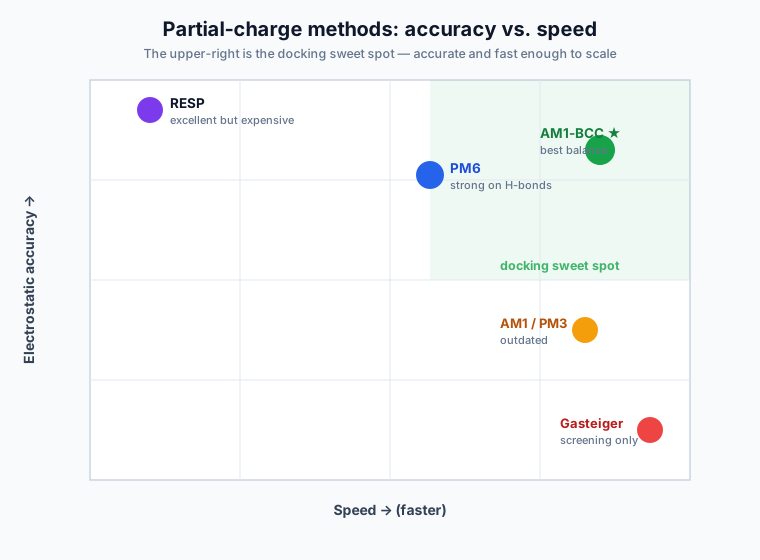
The recommended methods
1. AM1-BCC - the workhorse
AM1-BCC (Austin Model 1 with Bond Charge Corrections) was designed for exactly this job: reproducing the RESP / HF/6-31G* electrostatic potential without the quantum-mechanical price tag. It runs a fast AM1 calculation, then applies empirical bond charge corrections that pull the charges toward what an expensive RESP fit would have given.
- Accuracy: High - comparable to RESP in many cases, with per-atom errors typically < 0.1 e.
- Designed for: Reproducing RESP (HF/6-31G*) electrostatic potentials.
- Speed: Fast; suitable for high-throughput docking.
- Best use case: Ligands in protein–ligand docking.
- Tools:
Antechamber(AmberTools), OpenEyeQUACPAC, and RDKit via wrappers.
This is the default I’d reach for in any docking pipeline where electrostatic accuracy matters but full QM charges are out of budget.
# AM1-BCC charges with Antechamber (AmberTools)
antechamber -i ligand.mol2 -fi mol2 \
            -o ligand_bcc.mol2 -fo mol2 \
            -c bcc -nc 0      # -nc = net charge
2. PM6 - when polarization matters
PM6 (Parametric Method 6) is a more modern semi-empirical Hamiltonian that improves on older AM1/PM3 parameterizations, especially for polar interactions and hydrogen bonding.
- Accuracy: Higher than AM1 and PM3, particularly for polar and H-bonding systems.
- Speed: Slower than AM1-BCC, but still far faster than full ab initio methods.
- Tools:
MOPAC, Gaussian, and other quantum packages. - Best use case: Challenging systems where a better description of polarization or hydrogen bonding is needed.
# MOPAC input for PM6 charges
PM6 CHARGE=0 MULLIK PRECISE
ligand
The methods to avoid (or use only as fallbacks)
AM1 or PM3 - legacy
On their own, AM1 and PM3 offer only moderate-to-low accuracy: their electrostatic potential reproduction is weaker and the parameterizations are dated. They’ve largely been superseded by AM1-BCC (which builds on AM1 but corrects it) and PM6. Treat them as historical, or as a fallback when neither BCC nor PM6 is available in your toolchain.
Gasteiger - screening only
Gasteiger charges are very fast and convenient - which is why they’re the default in many docking tools - but their accuracy is poor. They’re fine for a quick pre-filter or preliminary triage of a large library, but don’t use them for final pose prediction or affinity ranking.
Benchmarking takeaways
The comparisons that keep showing up:
- AM1-BCC approximates RESP well. Across diverse ligand sets, AM1-BCC reproduces RESP charges with errors below ~0.1 e for most atoms - close enough that the two often give comparable docking behavior.
- Better charges, better docking. Ligands parameterized with AM1-BCC or RESP charges tend to yield improved enrichment factors, more accurate pose prediction, and stronger correlation with experimental binding energies than crude alternatives.
- Gasteiger lags. The speed advantage doesn’t survive contact with the accuracy requirements of final scoring.
A practical decision guide
The method follows the stage of the campaign, and how much of the question is electrostatic.
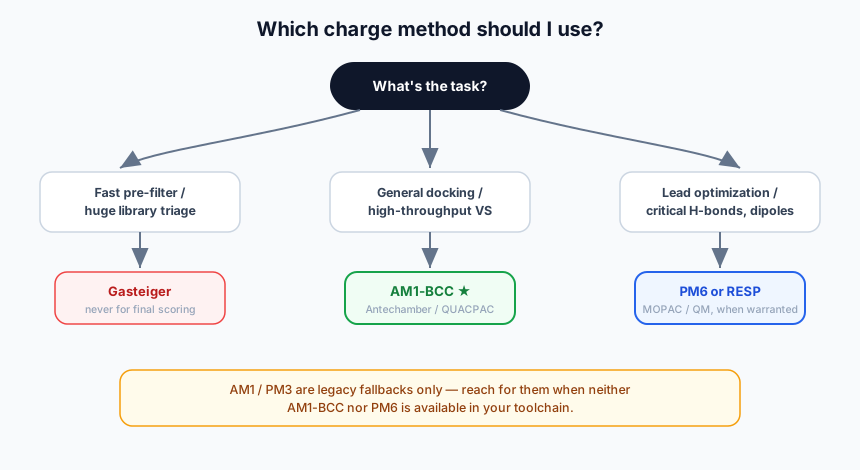
- General docking pipelines (AutoDock, GOLD, Glide): use AM1-BCC. It’s the dependable default.
- Lead optimization, or any case where accurate hydrogen bonding or dipole modeling is critical: step up to PM6 or DFT-based RESP charges.
- Preliminary screening / huge library triage: Gasteiger is acceptable for the first cut - but re-charge survivors with AM1-BCC before you trust any score.
Summary
| Method | Accuracy | Speed | Electrostatic quality | Recommended for docking |
|---|---|---|---|---|
| AM1-BCC | High | Fast | Very good | ✅ Yes |
| PM6 | High | Medium | Good (better than AM1) | ✅ Yes |
| AM1 / PM3 | Moderate | Fast | Moderate to poor | ⚠️ Sometimes |
| Gasteiger | Low | Very fast | Poor | ❌ No |
| RESP | Very high | Slow | Excellent | ★ Best, but expensive |
The short version: default to AM1-BCC for the bulk of your docking, reserve PM6 or RESP for the moments that demand it, and keep Gasteiger to the screening stage only. Getting the charges right is one of the cheapest ways to make a docking pipeline more trustworthy.