From Molecules to Decisions: My Takeaways from EFMC-ISMC 2026
What EFMC-ISMC 2026 revealed about the changing practice of drug discovery: from generative chemistry and automated DMTA cycles to allosteric pockets, DMPK liabilities, and human decision-making.
Sep 21, 2026
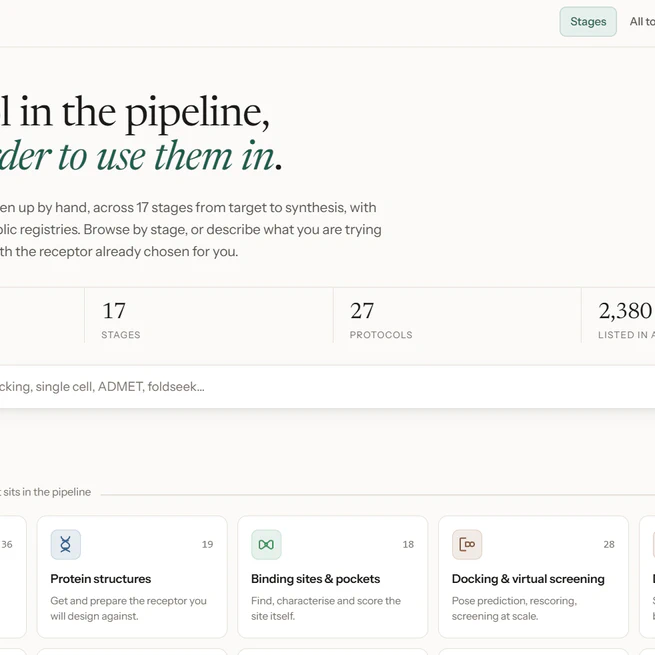
Assayer
A curated catalogue of 3,973 tools for medicinal and computational chemistry, paired with 27 actionable protocols guiding step-by-step drug discovery workflows, target validation against UniProt, and real-time PDB structure prioritization.
Sep 13, 2026
You Are Not an Impostor: Agentic Coding and the New Computational Scientist
A pipeline I never wrote a line of worked flawlessly on the first try, and it left me with impostor syndrome. Here is why relying on AI agents is not cheating, but a permanent shift in what scientific expertise actually means.
Jun 23, 2026
Choosing the Right Partial Charges for Molecular Docking: AM1-BCC, PM6 and Beyond
Partial charges quietly drive the electrostatics behind every docking score. This guide compares the common semi-empirical options - AM1-BCC, PM6, AM1/PM3, Gasteiger and RESP - and gives a practical recommendation for when to use each.
Jun 23, 2026
Building a 3D Pharmacophore Model from PDB Data: A Free Python Workflow
A step-by-step, fully open-source pipeline that turns raw Protein Data Bank structures into a ligand-based 3D pharmacophore - mining the PDB, aligning binding pockets, clustering ligands, fixing bond orders, and distilling a consensus feature map ready for virtual screening.
Jun 23, 2026
Does data leakage really inflate binding-affinity GNNs? A laptop-scale reproduction
I tried to reproduce the well-known PDBbind data-leakage effect with a small 3D GNN on a laptop - and couldn't. Two independent diagnostics show why: leakage only inflates models strong enough to memorize.
Jun 19, 2026
A Practical Guide to QSAR Model Validation: Internal, Cross, and External Checks
A three-tier QSAR validation framework: internal statistics, cross-validation, and external checks, with the thresholds used for papers and regulatory submissions.
Jun 1, 2026
Computational Strategies for Accelerating Drug Discovery: A Comprehensive Review
A comprehensive walkthrough of cheminformatics, machine learning, molecular docking, ADMET prediction, and molecular dynamics simulations as the modern toolbox for computer-aided drug discovery.
May 10, 2026
Beyond 2D Fingerprints: Encoding Protein-Ligand Interactions for Machine Learning
A practical guide to three advanced 3D fingerprinting methods (PLEC, SPLIF, and E3FP) and how to choose between them when featurizing docking poses for ML-based drug discovery models.
Apr 1, 2026
Understanding Binding Energetics in Molecular Docking
Conceptual overview of the key energetic contributions governing protein–ligand binding in molecular docking, including desolvation, entropy, water displacement, electrostatics, and scoring function behavior.
Mar 13, 2026