Sorbent
A deterministic compound triage service for molecular libraries. Ranks, deduplicates, and flags structural liabilities from SMILES inputs using transparent, citable RDKit descriptors and published structural alert catalogs.
Sep 22, 2026
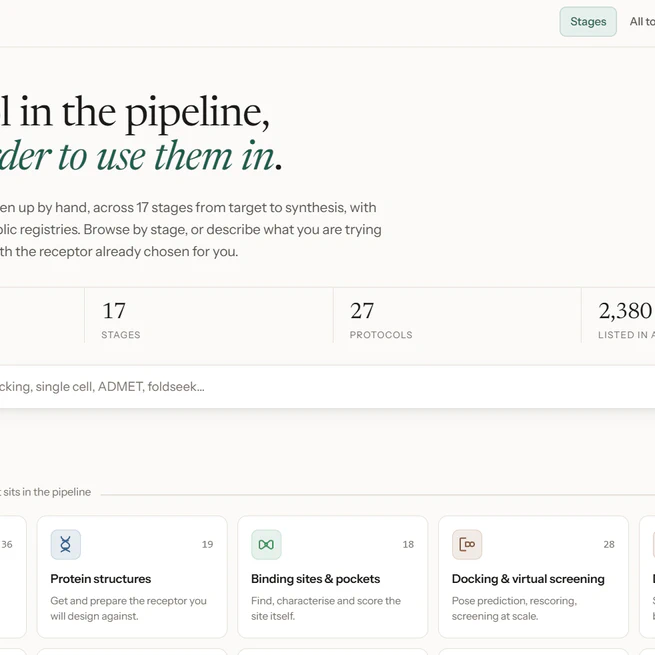
Assayer
A curated catalogue of 3,973 tools for medicinal and computational chemistry, paired with 27 actionable protocols guiding step-by-step drug discovery workflows, target validation against UniProt, and real-time PDB structure prioritization.
Sep 13, 2026
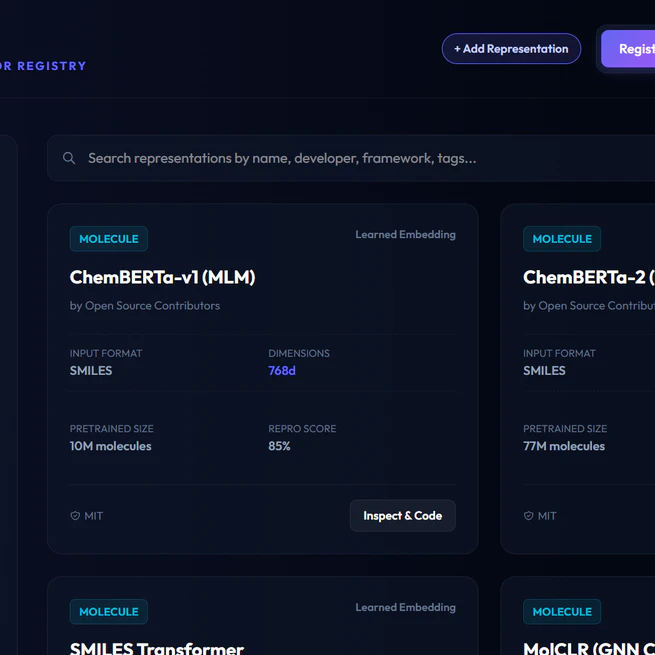
BioLatent
An open-access registry, selection wizard, and interactive benchmark dashboard for chemical and biological vector representations. Indexes foundation models across five modalities: small molecules, proteins, complexes, chemical reactions, and nucleic acids, with a programmatic JSON API.
Jul 16, 2026
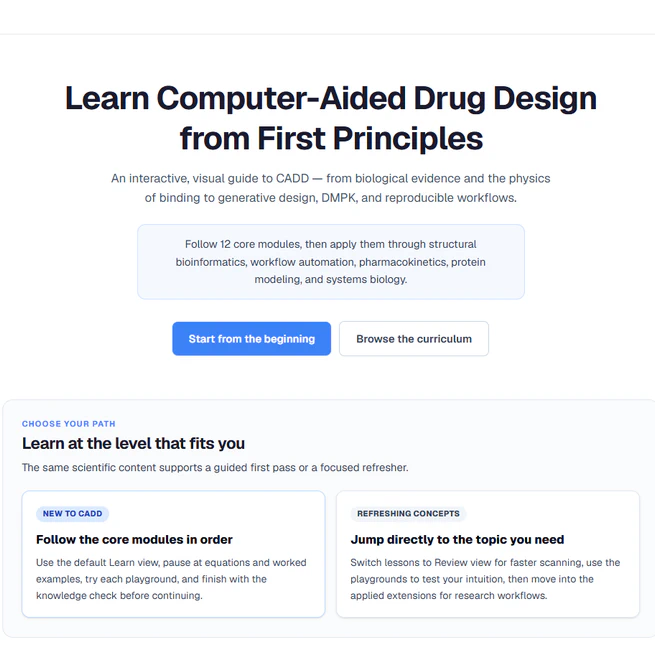
Learn CADD
An interactive, visual, first-principles web guide to computer-aided drug design. Covers 18 modules across ligand-receptor binding, molecular docking, pharmacophore modeling, QSAR, molecular dynamics, generative design, and ADMET prediction, each with hands-on browser playgrounds.
Jun 24, 2026
QSARBoost
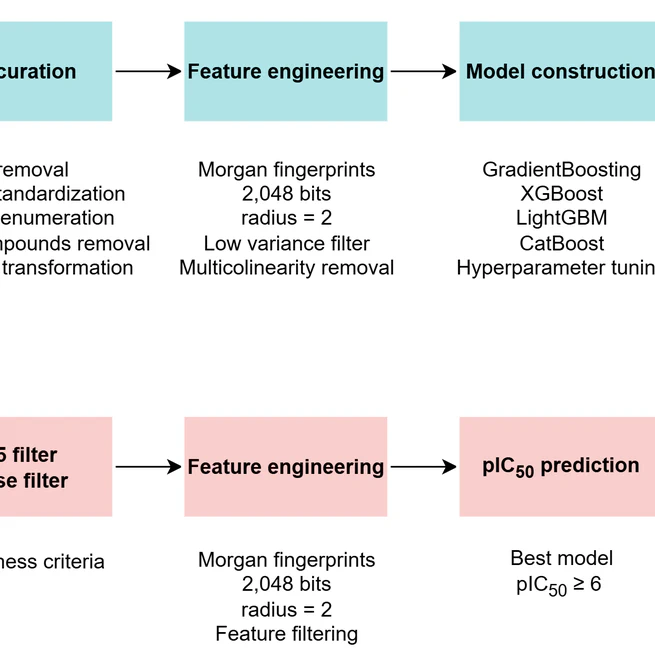
A flexible Python framework for building, validating, and applying gradient boosting-based QSAR models, with built-in support for molecular fingerprints, hyperparameter optimization, and model interpretation.
Aug 9, 2025
You Are Not an Impostor: Agentic Coding and the New Computational Scientist
A pipeline I never wrote a line of worked flawlessly on the first try, and it left me with impostor syndrome. Here is why relying on AI agents is not cheating, but a permanent shift in what scientific expertise actually means.
Apr 23, 2025
Building a 3D Pharmacophore Model from PDB Data: A Free Python Workflow
A step-by-step, fully open-source pipeline that turns raw Protein Data Bank structures into a ligand-based 3D pharmacophore - mining the PDB, aligning binding pockets, clustering ligands, fixing bond orders, and distilling a consensus feature map ready for virtual screening.
Mar 2, 2025
Does data leakage really inflate binding-affinity GNNs? A laptop-scale reproduction
I tried to reproduce the well-known PDBbind data-leakage effect with a small 3D GNN on a laptop - and couldn't. Two independent diagnostics show why: leakage only inflates models strong enough to memorize.
Jan 9, 2025
Understanding Binding Energetics in Molecular Docking
Conceptual overview of the key energetic contributions governing protein–ligand binding in molecular docking, including desolvation, entropy, water displacement, electrostatics, and scoring function behavior.
Jun 16, 2024
Practical System Preparation Tips for Molecular Dynamics Simulations
Practical choices that change MD results before the simulation starts: solvent box shape, protein termini, and how to pick a representative conformation.
May 21, 2024