Beyond SMILES: The Evolving Landscape of Molecular Representations
A concise overview of how molecules and chemical knowledge are represented for machines and humans alike, from SMILES strings to LLM-based agents.
May 17, 2026
Beyond Parameter Counts: The Shift Toward Rigorous Evaluation in Scientific AI
Limitations of scale-based evaluation in structural biology, and the transition toward physical grounding, out-of-distribution generalization, and biophysical developability validation.
Aug 30, 2025
Ensemble Docking for Binding and Activity Prediction
Limitations of static single-structure docking for flexible targets, and an integrated workflow combining molecular dynamics, clustering, and machine learning.
Jun 14, 2025
You Are Not an Impostor: Agentic Coding and the New Computational Scientist
A pipeline I never wrote a line of worked flawlessly on the first try, and it left me with impostor syndrome. Here is why relying on AI agents is not cheating, but a permanent shift in what scientific expertise actually means.
Apr 23, 2025
Reproducible ≠ Robust: Why One UMAP Seed Isn't Enough to Trust a Split
Pinning random_state=42 makes a UMAP-based train/test split perfectly reproducible - and that is exactly why it can lull you into a false sense of rigor. Reproducibility guarantees you get the same answer every run; it says nothing about whether that answer is typical. Here's the distinction, why it matters for evaluating GNNs on chemical-domain shifts, and how to fix it.
Mar 28, 2025
Does data leakage really inflate binding-affinity GNNs? A laptop-scale reproduction
I tried to reproduce the well-known PDBbind data-leakage effect with a small 3D GNN on a laptop - and couldn't. Two independent diagnostics show why: leakage only inflates models strong enough to memorize.
Jan 9, 2025
A History of Graph Neural Networks in Drug Discovery
From fingerprints and QSAR to 3D attention-based models operating on protein-ligand complexes: how graph neural networks reshaped computational drug discovery.
Dec 14, 2024
Beyond 2D Fingerprints: Encoding Protein-Ligand Interactions for Machine Learning
A practical guide to three advanced 3D fingerprinting methods (PLEC, SPLIF, and E3FP) and how to choose between them when featurizing docking poses for ML-based drug discovery models.
Jul 12, 2024
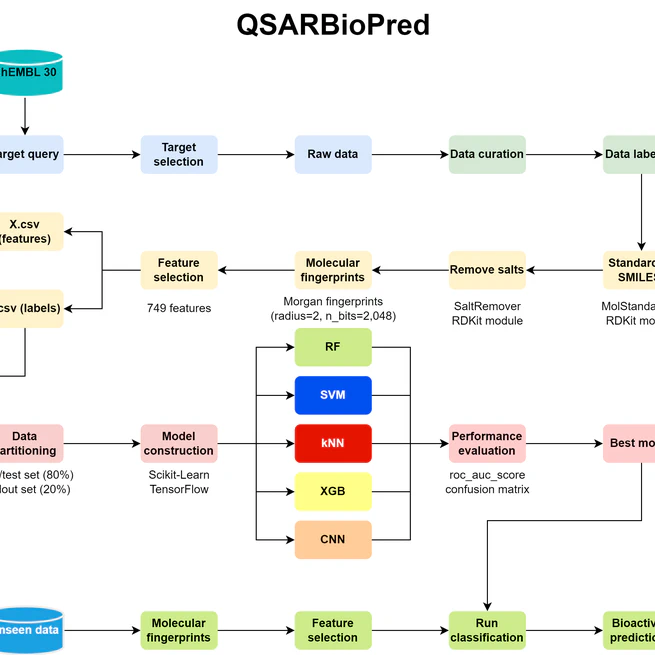
QSARBioPred
A Jupyter Notebook pipeline for building QSAR classification models for bioactivity prediction, supporting descriptor calculation, feature selection, model training, and applicability domain assessment.
Feb 20, 2024
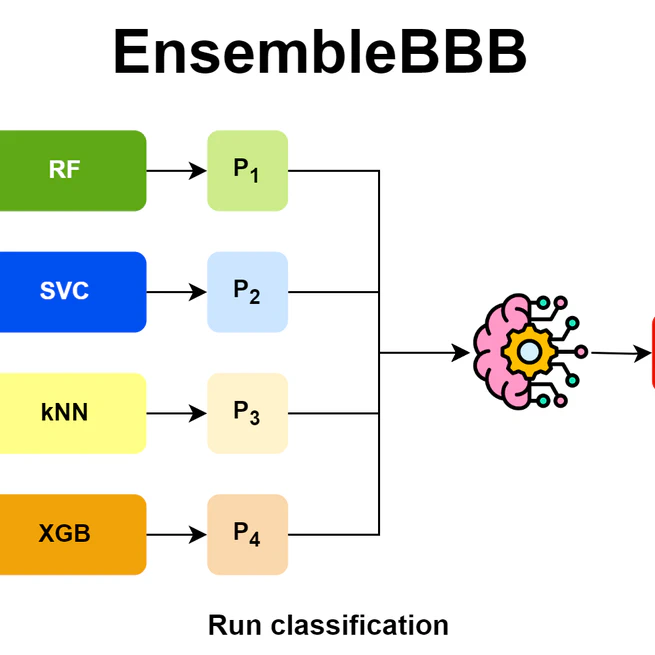
EnsembleBBB
A machine learning ensemble for predicting drug blood-brain barrier permeability. The models, fingerprints, and prediction script are in the GitHub repository. The hosted Streamlit app currently asks visitors to sign in, so the repository is the public entry point.
Feb 13, 2024