Honest QSAR Models Start With the Assay, Not the Algorithm
Tamsin Mansley and Mario Öeren's Optibrium webinar puts a QSAR in a fixed order: curate the assay, match regression or a class to the noise, hold out a test set that is scored once, and read the plot. A clearance label can still be the wrong target, because one number mixes several mechanisms.
Oct 25, 2026
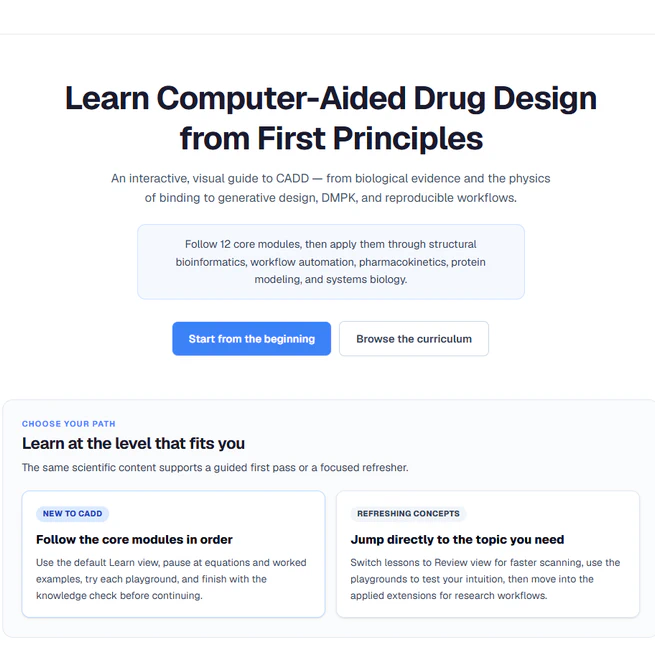
Learn CADD
An interactive, visual, first-principles web guide to computer-aided drug design. Covers 18 modules across ligand-receptor binding, molecular docking, pharmacophore modeling, QSAR, molecular dynamics, generative design, and ADMET prediction, each with hands-on browser playgrounds.
Jun 24, 2026
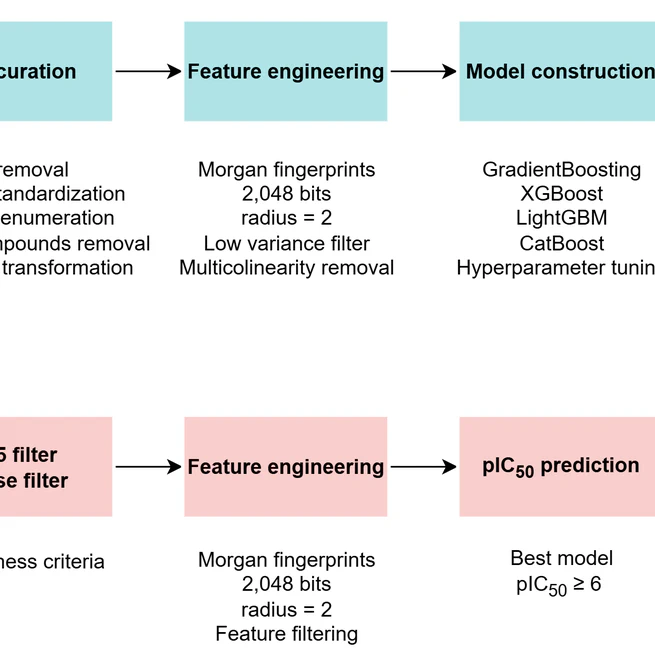
QSARBoost
A flexible Python framework for building, validating, and applying gradient boosting-based QSAR models, with built-in support for molecular fingerprints, hyperparameter optimization, and model interpretation.
Aug 9, 2025
Protein Descriptors for Machine Learning in Drug Discovery
A practical map of protein and protein-ligand descriptors for machine learning modeling, from sequence-only features to MD-derived structural and interaction features.
Aug 4, 2025
A Practical Guide to QSAR Model Validation: Internal, Cross, and External Checks
A three-tier QSAR validation framework: internal statistics, cross-validation, and external checks, with the thresholds used for papers and regulatory submissions.
Nov 18, 2024
Computational Strategies for Accelerating Drug Discovery: A Comprehensive Review
A comprehensive walkthrough of cheminformatics, machine learning, molecular docking, ADMET prediction, and molecular dynamics simulations as the modern toolbox for computer-aided drug discovery.
Sep 28, 2024
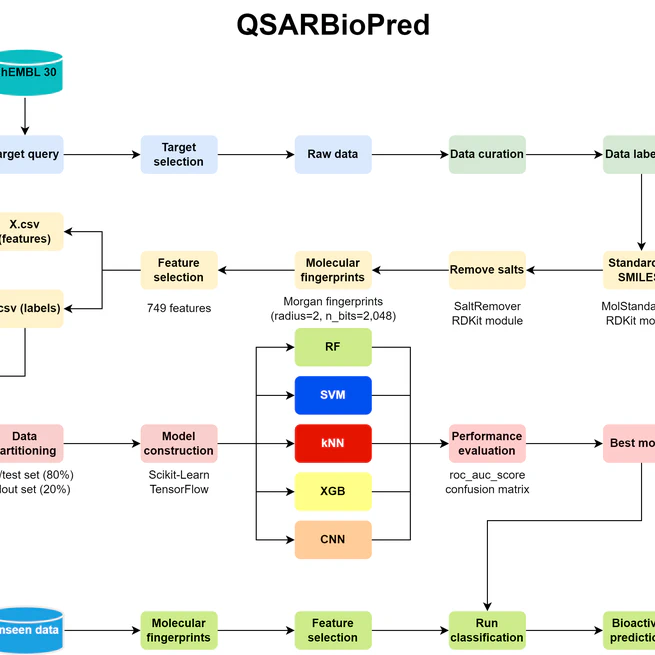
QSARBioPred
A Jupyter Notebook pipeline for building QSAR classification models for bioactivity prediction, supporting descriptor calculation, feature selection, model training, and applicability domain assessment.
Feb 20, 2024
Using PaDELPy to Generate Molecular Fingerprints for Machine Learning-Based QSAR
Turn a SMILES table into PaDEL fingerprints and a random forest, then score a held-out split with Matthews correlation. The cross-validation number is computed, not assumed.
Jan 15, 2023