Sorbent
A deterministic compound triage service for molecular libraries. Ranks, deduplicates, and flags structural liabilities from SMILES inputs using transparent, citable RDKit descriptors and published structural alert catalogs.
Sep 22, 2026
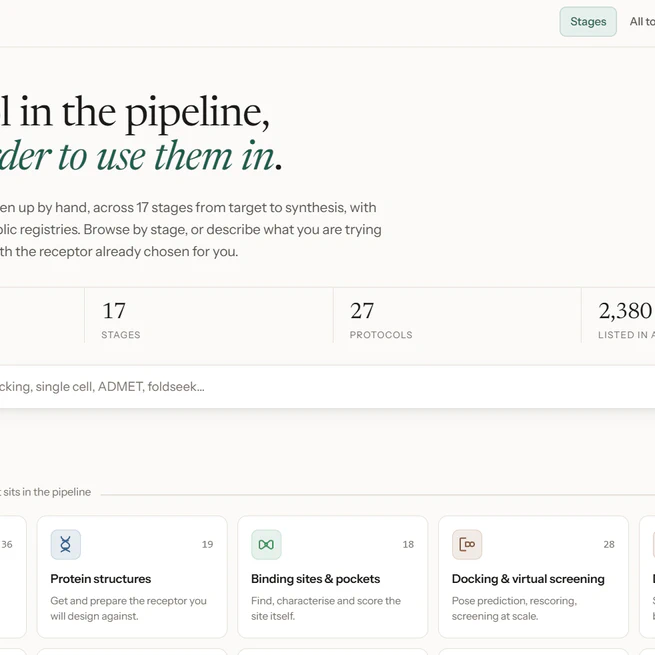
Assayer
A curated catalogue of 3,973 tools for medicinal and computational chemistry, paired with 27 actionable protocols guiding step-by-step drug discovery workflows, target validation against UniProt, and real-time PDB structure prioritization.
Sep 13, 2026
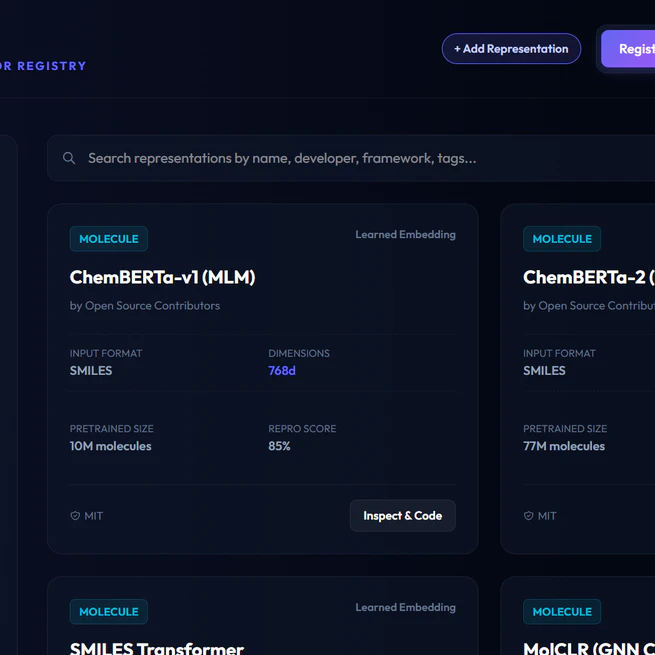
BioLatent
An open-access registry, selection wizard, and interactive benchmark dashboard for chemical and biological vector representations. Indexes foundation models across five modalities: small molecules, proteins, complexes, chemical reactions, and nucleic acids, with a programmatic JSON API.
Jul 16, 2026
Beyond SMILES: The Evolving Landscape of Molecular Representations
A concise overview of how molecules and chemical knowledge are represented for machines and humans alike, from SMILES strings to LLM-based agents.
May 17, 2026
What Agentic Engineering Means for Computational Drug Discovery
What agentic coding changes for computational drug discovery: reliability, the shift of the bottleneck onto validation, and where domain judgment still decides the science.
Apr 21, 2026
Protein Descriptors for Machine Learning in Drug Discovery
A practical map of protein and protein-ligand descriptors for machine learning modeling, from sequence-only features to MD-derived structural and interaction features.
Aug 4, 2025
Beyond Static Models: Agentic AI and Multi-Agent Systems in Drug Discovery
AI in drug discovery is moving past one-shot predictions toward autonomous agents that plan experiments, write their own analysis code, call docking and QM tools, and critique their results. Here's what the shift means, the design patterns behind it, and five open-source agents worth examining - with an honest look at the caveats.
May 19, 2025
Reproducible ≠ Robust: Why One UMAP Seed Isn't Enough to Trust a Split
Pinning random_state=42 makes a UMAP-based train/test split perfectly reproducible - and that is exactly why it can lull you into a false sense of rigor. Reproducibility guarantees you get the same answer every run; it says nothing about whether that answer is typical. Here's the distinction, why it matters for evaluating GNNs on chemical-domain shifts, and how to fix it.
Mar 28, 2025
Building a 3D Pharmacophore Model from PDB Data: A Free Python Workflow
A step-by-step, fully open-source pipeline that turns raw Protein Data Bank structures into a ligand-based 3D pharmacophore - mining the PDB, aligning binding pockets, clustering ligands, fixing bond orders, and distilling a consensus feature map ready for virtual screening.
Mar 2, 2025
Choosing the Right Partial Charges for Molecular Docking: AM1-BCC, PM6 and Beyond
Partial charges quietly drive the electrostatics behind every docking score. This guide compares the common semi-empirical options - AM1-BCC, PM6, AM1/PM3, Gasteiger and RESP - and gives a practical recommendation for when to use each.
Feb 4, 2025